





Radio advertising remains one of the most cost-effective ways to reach a targeted local audience. But before you book your first campaign, understanding the terminology will save you money and get better results.
From how your ad is placed to how much it costs to produce, each term carries real financial and strategic implications. Here is a plain-English breakdown of the key concepts.
Spot Buy
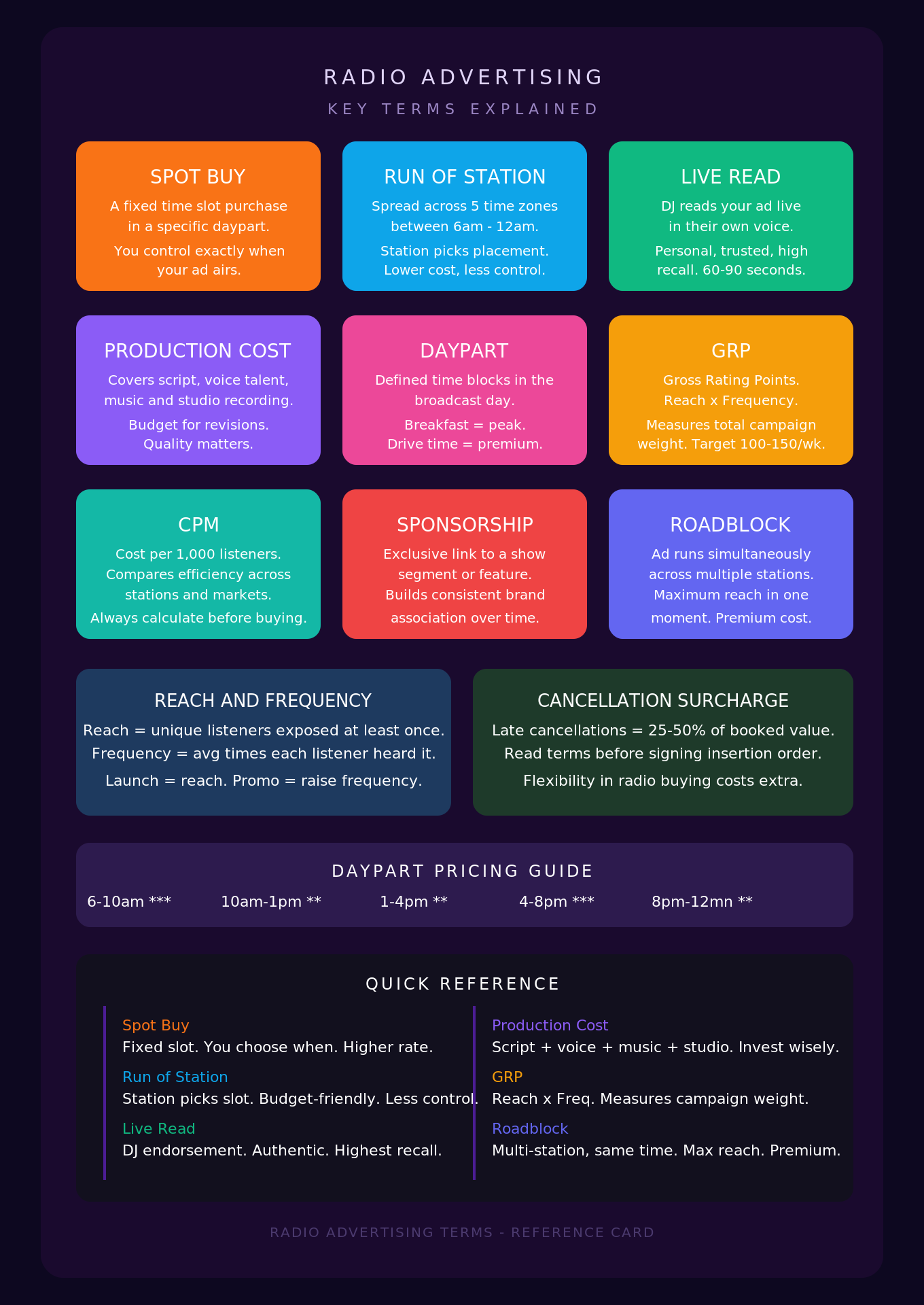
A spot buy is the most straightforward form of radio advertising. You purchase a specific time slot — a “spot” — within a defined time zone or programme segment.
You know exactly when your ad will air. If your business targets the morning commute crowd, you can lock in a 7:15am slot and reach listeners when they are most alert and receptive.
Spot buys typically cost more than run-of-station placements because you are paying for precision. Prime dayparts like breakfast and drive time command the highest rates due to peak listenership.
Run of Station (ROS)
Run of Station means your commercial is spread across multiple available time zones throughout the broadcast day, typically between 6am and midnight.
The station decides when your ad airs based on available inventory. You trade scheduling control for a significantly lower rate, making ROS ideal for budget-conscious advertisers with flexible objectives.
It works best when your message has broad appeal and does not rely on reaching listeners at a specific moment. Brand awareness campaigns and general promotions are well-suited to ROS placements.
Live Read
A live read is when the radio DJ or presenter reads your advertisement aloud, in their own voice, during a live broadcast — rather than playing a pre-recorded commercial.
It is one of the most powerful formats in radio because the endorsement feels personal and authentic. Listeners trust their favourite DJ, and that trust transfers naturally to the brand being mentioned.
Live reads are especially effective for local businesses, events, and products where a personal recommendation carries weight. They are typically longer — 60 to 90 seconds — and conversational in tone.
- Live reads generate higher recall than standard pre-recorded spots
- The DJ can personalise the message based on current events or mood
- They work particularly well for food, lifestyle, and entertainment brands
- Rates are higher due to exclusivity and the presenter’s personal involvement
- Most stations limit live reads to one advertiser per category per show
Production Cost
Production cost covers everything needed to create your radio commercial — scriptwriting, voiceover talent, music licensing, sound design, and studio recording time.
Some stations include basic production in their ad packages. Others charge separately, especially if you require a more polished execution with professional voice artists or bespoke music beds.
Budget at least one to two sessions of studio time for revisions. A poorly produced ad can undermine even the best media placement, so production quality is worth investing in from the start.
Daypart
A daypart refers to a defined segment of the broadcast day, grouped by typical listener behaviour. Each station divides its schedule into recognisable blocks with distinct audiences and pricing tiers.
Breakfast (6am – 10am)
The highest-rated daypart on most stations. Commuters, office workers, and families tuning in during their morning routines give this slot the largest and most engaged audience of the day.
Mid-Morning and Afternoon (10am – 4pm)
Solid reach among stay-at-home listeners, remote workers, and retail shoppers. Lower rates than breakfast, but audience quality remains strong for lifestyle and consumer goods brands.
Drive Time (4pm – 8pm)
The second-highest premium slot. Evening commuters and post-work listeners are captured during this window, making it ideal for food delivery, entertainment, and retail promotions.
Gross Rating Points (GRP)
GRP measures the total weight of your campaign by multiplying reach by frequency. A campaign with a GRP of 200 could mean 50% of your target audience heard your ad four times, or 20% heard it ten times.
It is a standard metric for comparing campaigns across different stations and markets. A higher GRP does not always mean better results — relevance and creative quality still determine whether those impressions convert.
- GRP = Reach (%) × Frequency (number of times heard)
- Most brand campaigns target a minimum of 100–150 GRP per week to build recall
- Short burst campaigns with high GRP can outperform long, low-intensity runs
- GRP helps compare value across stations with different audience sizes
- Always ask your station rep for GRP projections before finalising your buy
Reach and Frequency
Reach is the number of unique listeners exposed to your ad at least once. Frequency is how many times, on average, each listener heard it. Together, they define how broadly and how deeply your message penetrates the market.
For a new brand launch, prioritise reach to build initial awareness. For a time-sensitive promotion, increase frequency so your offer is top of mind when the listener is ready to act.
Cost Per Thousand (CPM)
CPM tells you how much you are paying to reach one thousand listeners with your message. It is the go-to metric for comparing efficiency between stations, markets, and formats.
A station with higher rates might still deliver a lower CPM if its audience is significantly larger. Always calculate CPM when evaluating proposals — the sticker price alone is never the full picture.
Sponsorship and Roadblock
A sponsorship links your brand exclusively to a specific programme, segment, or feature — like the traffic update or the top 40 chart countdown. It builds consistent association between your brand and a recurring moment listeners love.
A roadblock is when your ad runs simultaneously across multiple stations or programmes at the exact same time, maximising reach in a single moment. It is often used for major product launches or campaigns that need immediate mass awareness.
- Sponsorships build long-term brand association with a programme’s audience
- Roadblocks are best for time-critical announcements or sale launches
- Both formats typically come with exclusivity, keeping competitors off your segment
- Sponsorship packages often include live reads, banners, and social media mentions
- Roadblock rates are premium but deliver unmatched short-term penetration
- Negotiate early — both formats sell out quickly around peak seasons
Cancellation Surcharge
Most stations require confirmed bookings within a set window before air date. Cancelling outside that window triggers a surcharge — typically 25% to 50% of the booked value — to compensate for unsold inventory.
Always read cancellation terms before signing an insertion order, especially if your campaign is tied to an event or product launch that could be postponed. Flexibility costs extra in radio buying.
Final Thoughts
Radio advertising rewards planners who understand the language. Knowing the difference between a spot buy and a run-of-station placement — or why a live read outperforms a standard spot — puts you in a stronger position to negotiate, optimise, and measure your campaign effectively.
Work closely with your station rep to align your objectives with the right format, daypart, and budget. The best radio campaigns are not the loudest — they are the most strategically placed.